






Multiple Stud Nut (MSN)
Axial Bolt Tensioning using torque
Simple way to achieve a torsion-free axial preload force with increased assembly effort. The MSN replaces the standard nut in a bolted connection.

Basic position
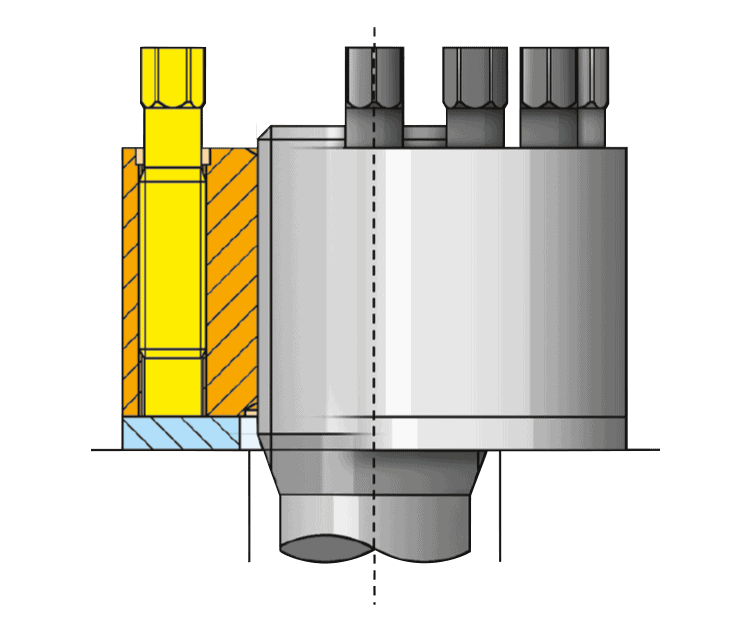
The MSN is screwed onto the bolt being tightened until lying at the clamping disc. The Jackbolts are integrated into the nut body and ready for pretensioning generation.
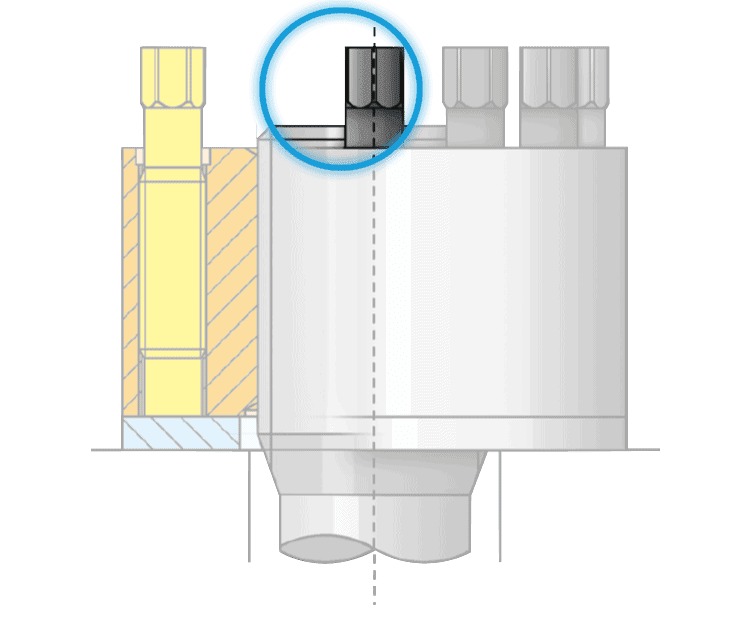
Bolt to tension
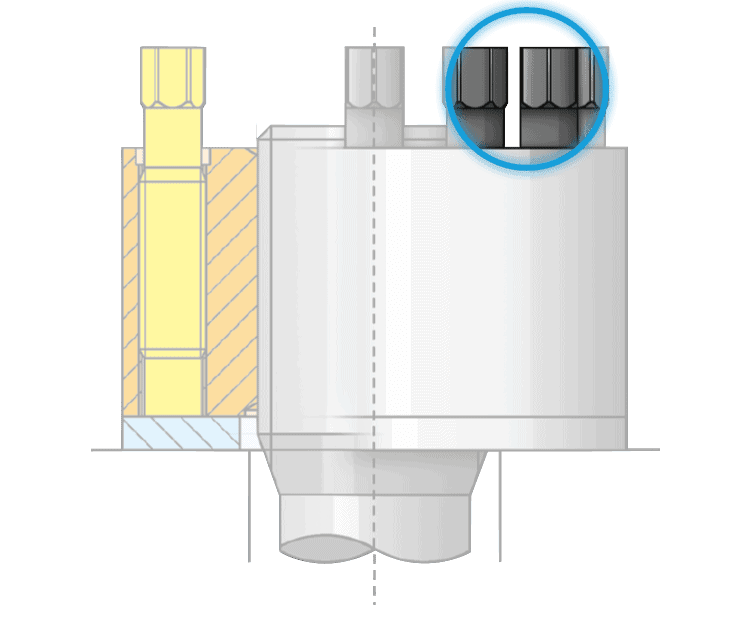
Jackbolt
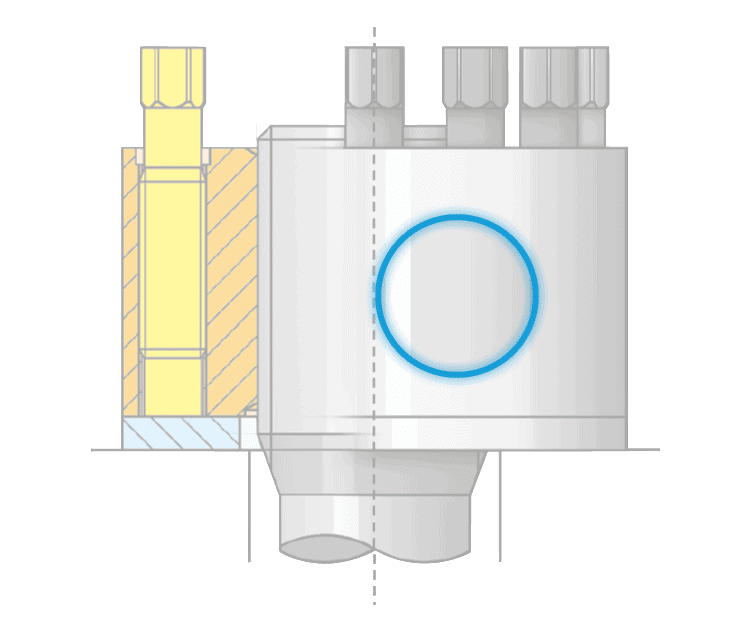
Nut body
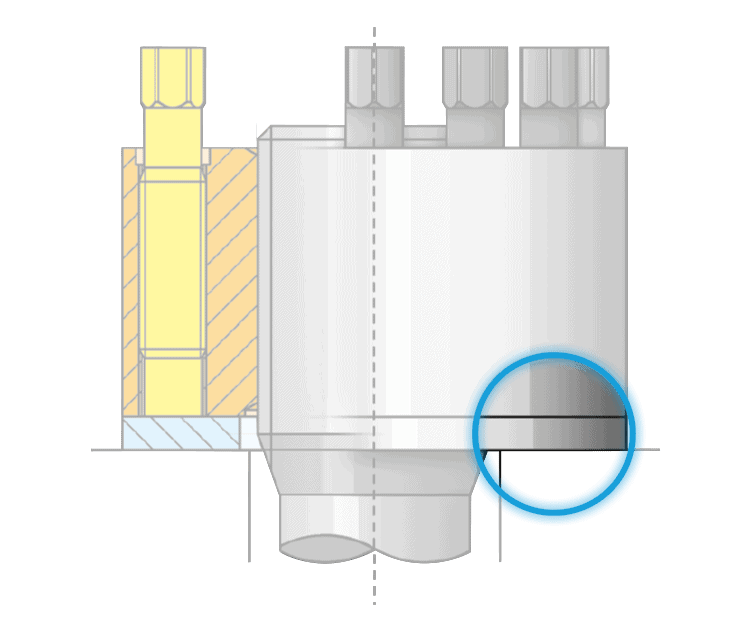
Disc
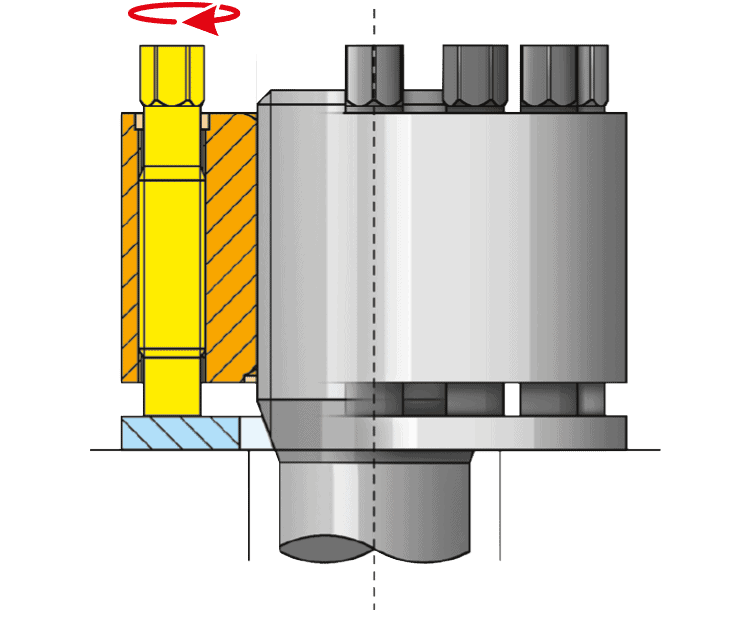
Elongation and compression
Due to the stepwise turning of the Jackbolts with torque, the axial pretensioning force is generated. The bolt being tightened is elongated and by leading in the force into the disc the flange parts are compressed.
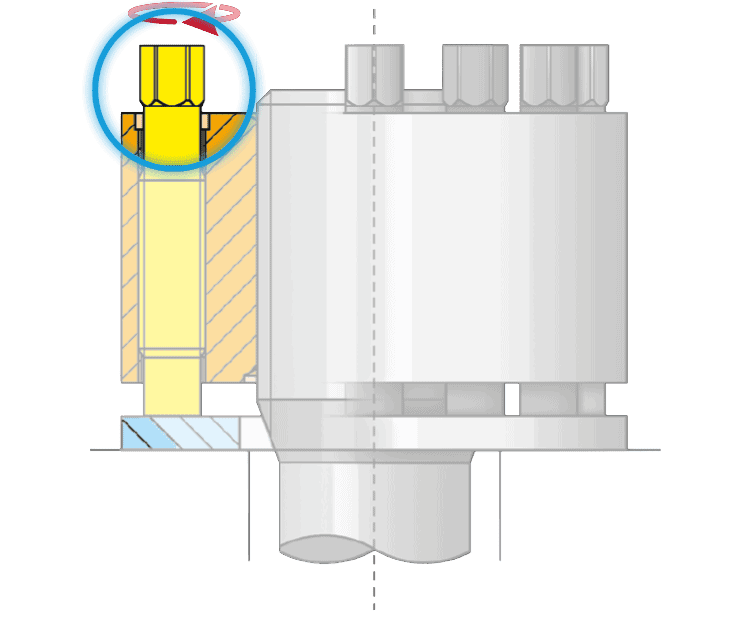
Pretensioning generation
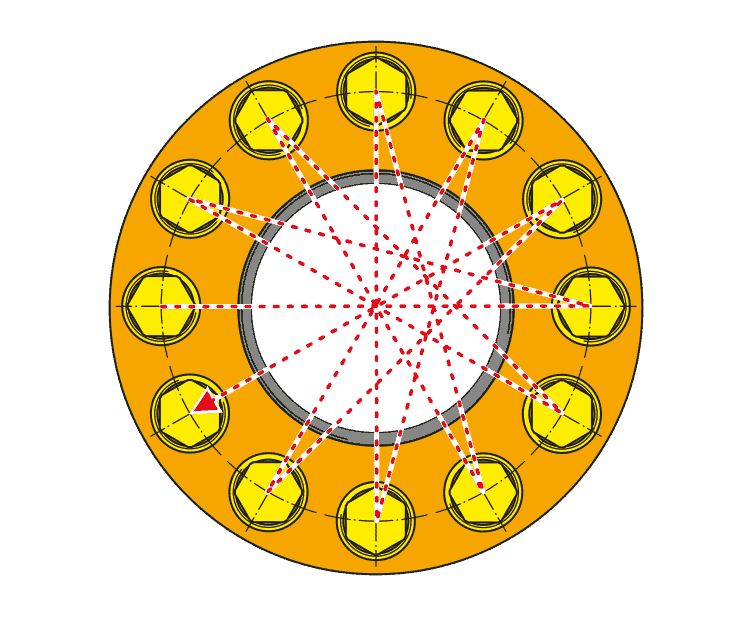
Pretensioning
After reaching the required torque, the pretensioning force of the bolt is achieved. The sum of the axial pressure forces of the Jackbolts is in accordance with the overall bolt pretensioning force (axial traction). The main bolt is pretensioned absolutely torsion-free. The Multiple Stud Nut automatically is protected against loosening.

The tightening occurs with stepwise tensioning of the jackbolts.
Advantages
The SCHAAF MSN – Multiple Stud Nuts offer you many advantages compared to conventional fixing devices and methods of mounting:
- Main bolt is pretightened 100 % torsion-free
- No torsion under load (no thread wear)
- Robust, durable and lightweight mode of construction
- Simple and easy mounting and dismantling
- Permanent maintenance-free connection
- Wide choice of sizes and designs
- Anytime quickest control possibility of the pretensioning force
- Mounting with many individuals possible
- Easy pretensioning control
- Tensioning locking at static, alternating and impact loads
- Improves the bolt lifetime because of gentle pretensioning force generation and pure axial load
Versions
The SCHAAF MSN – Multiple Stud Nuts can be manufactured/supplied as follows:
- Compact design
- Standard design
- High-tensile design
- Customer specific solutions up to Ø 1800 mm
- All sorts of threads, standards and others Power transmission elements as e. g. bayonet
- High-tensile steel
- Rust and acid-resistant steels
- Heat-resisting materials
- High-strength aluminium alloys
- Different material combinations
- Burnished, lacquered or chemically nickel-plated
- Requested by the customer
User-defined special designs possible.


Fields of Application
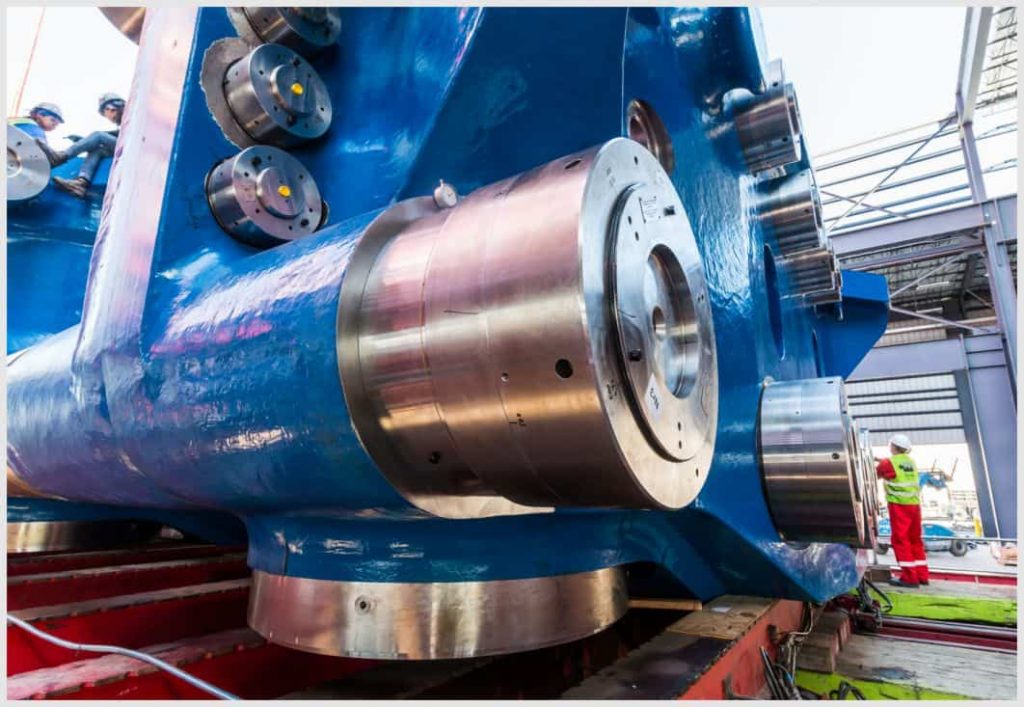
The MSN proves its worth wherever a secure and maintenance-free
connection must be guaranteed.
Examples: General mechanical engineering, Powerplant technology und Engines and gearboxes.
Quality Assurance
All MSN – Multiple Stud Nuts are checked for material quality, dimensional accuracy, proper operation and reliability. They are subject to quality assurance measures during order execution and delivered with detailed documentation.
Services
MSN are, of course, delivered packaged ready for installation and operation.
SCHAAF MSN are user-friendly, reliable and are manufactured in accordance with the highest level of technical know-how. Our highly-motivated staff will be pleased to train your personnel, in situ or at our works, in the general handling of MSN.
Related Accessories
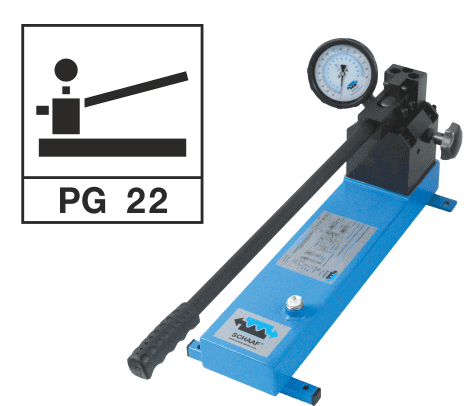
Fully assembled and ready for immediate use Hand lever pump up to 4,000 bar hydraulic pressure.
MEDIA AND MORE
Frequently Asked Questions about the Multiple Stud Nut (MSN)
A Multiple Stud Nut = MSN, is a mechanical multi-jackbolt tensioning nut for axially pretensioning large bolted connections. It replaces a conventional standard nut in a bolted connection and generates the torsion free axial pretensioning force using several Jackbolts integrated into the nut body.
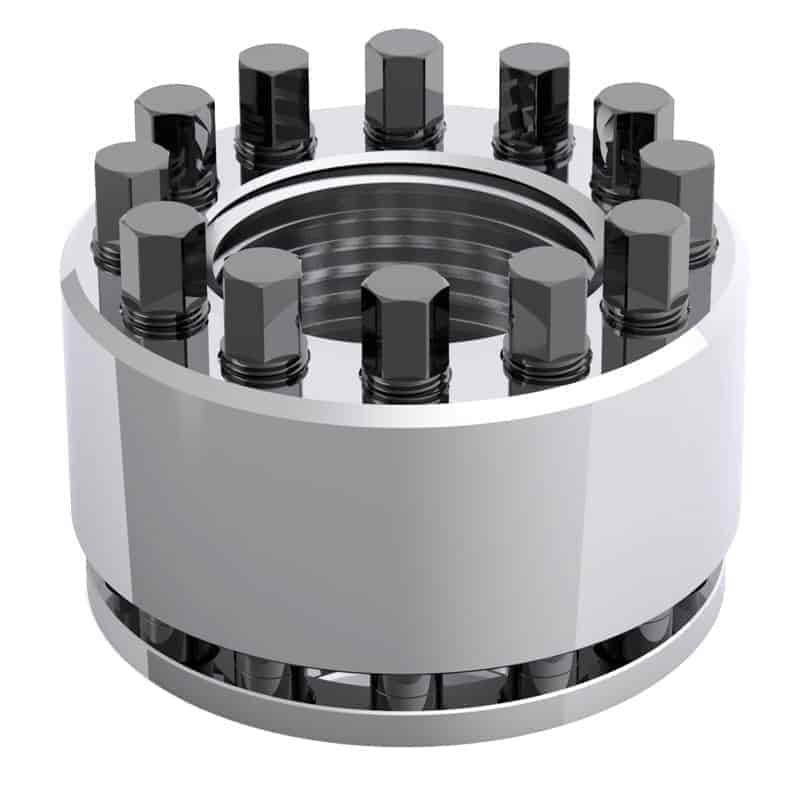
The term describes a nut with several Jackbolts arranged in its nut body. These Jackbolts transmit their forces axially into the connection via a clamping disc.
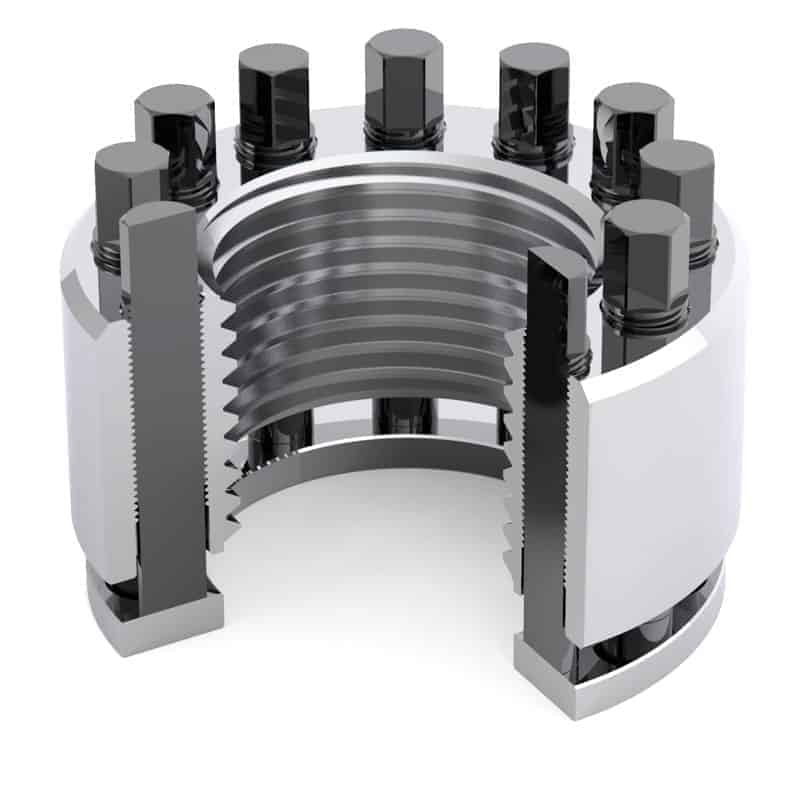
An MSN multi-jackbolt tensioning nut consists of three components:
1. Nut body: Has an internal thread that is screwed onto the main bolt, and a ring of threaded holes arranged on a pitch circle in the nut body.
2. Jackbolts: The smaller bolts are arranged in a bolt circle in the nut body.
3. Hardened washer: Protects the flange surface of the component from damage caused by the Jackbolts.
The MSN nut is screwed onto the main bolt until it rests against the clamping disc. The integrated Jackbolts are then tightened step by step in a crosswise sequence to a specified torque. This elongates the main bolt and compresses the connected flange parts.
The operating principle involves the nut body, several integrated Jackbolts and a clamping disc. Together, these components transmit the individual pressure forces of the Jackbolts as an torsion free axial pretensioning force to the main bolt.
First, the nut body is screwed onto the thread of the bolt to be tensioned until it reaches the clamping disc. The Jackbolts are then tightened gradually in a crosswise sequence using a torque wrench or powered torque tool until the specified torque is reached.
When tightened, each Jackbolt generates an axial pressure force. The sum of these individual pressure forces corresponds to the overall pretensioning force, or axial traction, of the main bolt. Pure axial clamping in the bolt and thread. No torsional stress in the main bolt with increased assembly effort.
Yes. Although the individual Jackbolts are tightened using torque, the main bolt is pretensioned purely axially and completely torsion-free.
The Jackbolts transmit their forces axially into the connection via the clamping disc. This elongates the main bolt without twisting it under load, preventing thread wear and friction losses caused by rotation of the main bolt.
Yes. The MSN replaces the standard nut in the bolted connection and the tool used to tension it. Thanks to its universal design, it can be screwed directly onto the thread of the main bolt.
No. The pretensioning force is generated mechanically by the Jackbolts. No hydraulic power unit is required for installation; the Jackbolts can be tightened using a suitable torque tool, such as a torque wrench.
The pretensioning force is set through the specified torque of the Jackbolts. The system also allows straightforward pretensioning control and a quick check of the existing pretensioning force.
Yes. Once the specified torque has been reached, the Multiple Stud Nut is automatically protected against loosening by the resulting self-locking effect.
Yes. The tensioning remains secured under static, alternating and impact loads.
Distributing the pretensioning force over several smaller Jackbolts simplifies mounting and dismantling of large bolted connections. At the same time, the main bolt is pretensioned purely axially and torsion-free. The high level of occupational safety allows a substantial reduction in the risk of accidents, thereby reducing the risk of injury.
Pretensioning force generation and pure axial loading avoid additional torsional stress on the main bolt. This can increase its service life. The main bolt can also be made smaller, saving material costs and weight.
The MSN is designed for permanent, maintenance-free connections. It is therefore particularly suitable for applications in which a secure connection must be guaranteed over the long term.
MSN axial pretensioning is used on bolts with thread diameters from 16 mm to 1,800 mm. The system is therefore also suitable for very large bolted connections.
In addition to the standard design, compact and high-tensile designs are available. Other tensioning nuts and tensioning systems include:
• Multiple Stud Nuts for dynamic applications
• Multiple Stud Bolt – multi-jackbolt tensioning bolt
• Multiple Stud Nuts for NACE or sour-gas applications
• Multiple Stud Nuts for high-temperature applications
• NACE-INOX Multiple Stud Nuts with protective cap
Multiple Stud Nuts can be designed for different thread types and standards, including metric threads, imperial threads and pipe threads. Other power transmission elements, such as bayonet connections, are also possible.
Possible materials include high-tensile quenched and tempered steel, rust- and acid-resistant steels, and heat-resisting materials. These also include NACE and NACE-INOX stainless steels. Different material combinations are also possible.
The surfaces of the tensioning nuts can be burnished, lacquered or chemically nickel-plated. Customer-specific surface finishes are also possible.
Multiple Stud Nuts are used in general mechanical engineering, powerplant technology, and engines and gearboxes, among other fields. Further applications include the steel and non-ferrous metals industry, structural and civil engineering, refineries, the chemical industry, research technology, and onshore and offshore applications.
Accessories include analogue and digital torque wrenches, electric, pneumatic and hydraulic powered torque tools, mechanical-hydraulic wrenches, hexagon sockets, protective caps and mounting aids. Lubricants and preservatives are also available, as is SCHAAF support with mounting kits.
SCHAAF GmbH & Co. KG in Erkelenz develops and manufactures tensioning nuts (Multiple Stud Nuts) for torsion-free axial pretensioning of large bolted connections. In addition to various standard designs, customer-specific special designs made from special materials and alloys are also manufactured.